With time and money tighter than ever, waterjet shops around the world
are looking for ways to maximize their water jet systems’ productivity and
profitability without breaking the bank on capital investments.
Waterjet industry veterans Jeff Schibley and Bradley Schwartz of Jet
Edge recently offered some helpful insights on how to increase waterjet
productivity and minimize waste without breaking the bank.
According to Schibley and Schwartz, there are numerous ways to increase
waterjet productivity, including X-Stream pressure pumps that can reach up to
90,000 psi (6200 bar), multiple-head systems that can include a dozen or more
cutting heads, mirroring programs that can cut large parts twice as fast by using
two cutting heads, and nesting software that can maximize parts per sheet or
plate. Ancillary equipment also can be
added to waterjet systems to increase their productivity, including abrasive
removal systems, garnet recycling systems, chiller and closed loop systems, Dual
Pressure Valves, height sensors and pneumatic drills.
All of these productivity enhancements serve an important dual purpose
of increasing a waterjet shop’s profitability and protecting our planet by
minimizing material waste and water and power consumption.
X-Stream Pressure
Pumps
For years, 60,000 psi (4100 bar) was the standard operating pressure for
most waterjet shops, but in the last five years, X-Stream pressure cutting
technology has made a dramatic entrance into the waterjet world. With pressures
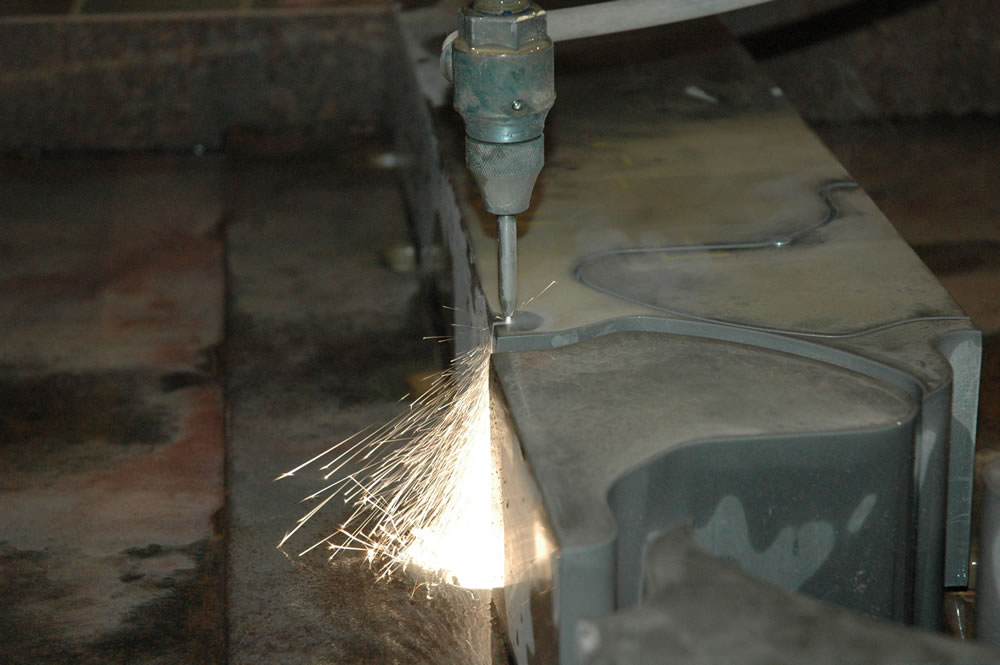
exceeding 90,000 psi, X-Stream pressure waterjets can increase cutting speed up
to 50%, depending on the material. By
cutting faster, X-Stream-powered systems use less power, water and abrasive,
reducing operating costs as much as 40%.
“Increasing pressure is where we can see tremendous efficiencies in the
abrasive waterjet cutting process,” said Schibley, who serves as Jet Edge’s Great
Lakes regional manager. “By pressurizing to higher pressures, we get faster
acceleration of the abrasive and we get more efficiency in the cutting
process.”
A great example is NASCAR’s Michael Waltrip Racing (MWR). MWR has seen tremendous productivity gains
since upgrading their waterjet intensifier pump to an X-Stream pressure
pump. Since upgrading to X-Stream
pressure, MWR has been able to reduce its
waterjet operating hours from 60 to 65 hours per week to 40 to 50 hours per
week, saving on labor and overhead.
"We've been seeing, across the board, a 35% improvement in cutting
speed, plus we are using about 25% less garnet abrasive, and we have reduced
our costs by 30%," said Nick Hughes, MWR's technical director.
"As an example, our spindles, which are one of our more complicated
steering parts and cut from 2" 4140 steel, used to take 50-55 minutes to
cut at 60,000 psi. Now we are cutting them in 30-44 minutes. Before we got the
waterjet, it used to take three or four hours to rough cut them on a band saw.
I also should note that about the same time we upgraded our pump, we changed
suppliers for our spindle blanks. They use a much harder material that requires
a slower cutting time. The X-Stream offset the increased cutting time.
"Another good example of a reduction in machining time would be our
upper control arm plates that attach our front suspension arms to the chassis.
These are cut from 1.5" thick steel and took about 1 hour and 25 minutes
to cut two with the double heads and the old 60KSI pump. We can now cut two in
about one hour with the double heads and the 90KSI pump."
How Select the Right
Waterjet Pump
But how do you know if an X-Stream pressure pump is right for your shop,
and how do you determine what horsepower of pump your shop needs?
Before investing in a waterjet system, ask the waterjet manufacturer to
perform a test cut, Schibley advised. Most
waterjet manufacturers provide free test cuts using material supplied by the
customer.
The test will help you determine how many cutting heads are necessary to
reach a desired throughput and how much horsepower is required to supply the
proper amount of water to each cutting head. It also will determine the most
efficient orifice/nozzle combination, pressure and abrasive feed rate for a
given application.
“We cut the part to determine how much energy is required,” Schibley
noted. “As an example, you say, a .010/.030
orifice/nozzle combination at 60,000 psi made my part, but not as fast as I
want. Well, I can run two .010/.030
nozzles with a 50hp pump or I can run four .010/.030 nozzles with a 100hp pump,
or I can run six .010/.030 nozzles with a 150hp pump. If I’m cutting much over
¾” thick material, I’m probably going to want to put a 50hp of energy into that
nozzle. I’m going to run at least a .010/.030
at 75,000 psi (5200 bar) or a .015/.045 at 60,000 psi. Depending on the throughput is how we
determine the horsepower, so if I run one head, I need 50hp, if I’m running two
heads, I might need 100 hp, if I’m running three, I might want 150hp, if I’m
running four, I might want 200 hp to feed the proper amount of water to that
nozzle.
“We’re trying to run as efficient a nozzle setup as we can. In a .010/.030
I can accelerate 0.6 pounds per minute of abrasive at 60,000 psi and I can
accelerate 0.7 pounds per minute at 75,000 psi.”
Multi-Head Systems
The quickest way to make a waterjet system more productive is to add
multiple cutting heads to the system, Schibley noted.
“Look at most successful job shops and what are they running?” Schibley
asked. “They are running two heads,
three heads, four heads. That’s
generally because we burden a machine with overhead costs and general and
administrative costs (G&A) based on that machine. We don’t burden each cutting head, so when we
start putting multiple heads on a machine it allows us to prorate our G&A
costs over a greater number of parts per cut.
So if I have $50 per hour for G&A costs and I’m running one head and
I’ve got $37 per hour operating costs, I’ve got $87 in costs and I haven’t made
a machine payment yet in operating that single head. Now if I go to two heads, what happens? If I have a 100hp pump and I’m operating two
nozzles, I still have my $37 to run each one of them, but my cost per part
dropped by $25 because I was able to prorate my overhead costs.”
Mirroring – Cut Large
Parts Twice as Fast
Adding optional mirroring capabilities to a waterjet system can be a
huge time saver, said Schwartz, who serves as Jet Edge’s Pacific regional
manager.
 Mirroring capabilities allow waterjet operators to cut large parts simultaneously
with two cutting heads, doubling productivity and freeing the machine and labor
for other projects.
Mirroring capabilities allow waterjet operators to cut large parts simultaneously
with two cutting heads, doubling productivity and freeing the machine and labor
for other projects.
Precision Waterjet Concepts of Pequot Lakes, Minn., is one example of a
shop that is saving time and money by mirroring parts with a Jet Edge Mid Rail
Gantry system that also features programmable head spacing.
"We cut a lot of extremely large parts and we can save a lot of
time and money by mirroring,” said Joe Quaal, Precision Waterjet Concepts
president. “Fifty percent of the time, we are mirroring. The programmable head
spacing also saves us 10-15 minutes per job on set up time."
Nesting Software –
Maximizes Material
“A good nesting program is very important for any system, especially if
you are looking at material that costs quite a lot and you’re doing high
volume,” Schwartz said. “You can look at the efficiency of the nesting software
and just conservatively see a 5% savings.
Nesting will give you a huge amount of cost savings in a year.”
Nesting software saves money and increases productivity by maximizing
the amount of parts that can be cut out of a piece of material. This reduces waste and minimizes the downtime
during loading and unloading of parts.
Nesting software can also be used to tab parts to prevent them from
falling into the waterjet tank or to keep them together in a sheet of material
so the entire sheet can be removed at once, speeding up loading and unloading.
One of Arro-Jet's customers needed to have parts cut from 20
84"X40" 3" thick titanium plates valued at $50,000 a plate. The customer expected to get nine parts out
of each plate, but Arro-Jet tightly nested the parts and cut 10 parts from each
plate. The customer received 20 extra
parts that they had not expected.
Pneumatic Drill
Pneumatic drills are an inexpensive accessory that can speed up waterjet
processing time by pre-drilling material that is sensitive to delamination, such
as polycarbonate or fiberglass, Schwartz explained.
The programming sequence will first run the drill, pre-drilling at
desired locations, then switch to the waterjet to finish the part. This increases productivity by allowing
waterjet operators to quickly pre-drill and cut sensitive material without
using a slower low-pressure pierce or long lead in cut to the part. It also allows shops to cut materials that
they may have avoided in the past due to delamination concerns.
Height Sensing
If you have ever had to shut down your system to replace a nozzle after
slamming into uneven material or a tipped up part, you know why a contact
height sensor is an invaluable waterjet accessory.
According to Schwartz, contact height sensors allow waterjet operators
to overcome significant fluctuations in material flatness by maintaining a
constant automatic standoff from the material. As a result, waterjet operators
achieve optimum cut quality, tolerance, taper and speed without having to
monitor the standoff. Height sensors also
can be programmed to avoid previously cut parts that may have tipped up after
being cut. Height sensors are also a necessity
in running underwater cutting operations since the operator cannot monitor the
“stand off distance” between the nozzle and material, Schwartz added.
Dual Pressure Valves
For shops whose work requires them to frequently raise and lower
pressure or do frequent low pressure pierces, Jet Edge’s patented Dual Pressure
Valve® offers a cost-effective solution to reducing wear and tear on pump
components and reducing downtime.
“In dual pressure cutting, we want the ability to peck our way through
material ever so gently with lower pressure water, and then as we get that hole
in there, we can increase the pressure,” Schibley explained. “In the case of glass, if I impact glass with
60,000 psi water, I’m going to get chips just like I’d get on my windshield
when I’m driving behind a gravel truck and it throws a stone at me. It’s going
to take a big chunk out of it. I don’t
want to make that big chunk. I want to
cut gently through there. Non-tempered glass cuts fine as long as we cut
through from an edge, so we peck a tiny hole in there and now we can boost to
high pressure.
 “But when you take a waterjet pump and you ramp that pressure up and
down, what occurs? Number one, when we ramp and load up and down on the
electric motor it causes it to use more electricity. It also causes us to
fatigue our high pressure components faster. High pressure components are
designed to be at maximum pressure. They like being at 60,000 psi, or 75,000
psi, or 40,000 psi, whatever your system runs at. What they don’t like is being
at that pressure and suddenly being depressurized. It’s that action that creates fatigue.”
“But when you take a waterjet pump and you ramp that pressure up and
down, what occurs? Number one, when we ramp and load up and down on the
electric motor it causes it to use more electricity. It also causes us to
fatigue our high pressure components faster. High pressure components are
designed to be at maximum pressure. They like being at 60,000 psi, or 75,000
psi, or 40,000 psi, whatever your system runs at. What they don’t like is being
at that pressure and suddenly being depressurized. It’s that action that creates fatigue.”
To overcome the wear and tear of dual pressure cutting, Jet Edge
introduced a patented Dual Pressure Valve® that can be used with any waterjet
system, Schibley explained. The valve
allows waterjet operators to raise and lower water pressure independent of the
waterjet pump.
“This allows us to reduce the pressure at the cutting head without having
to ramp our pump up and down,” Schibley explained. “So all the plumbing out to the cutting head
gets to stay at what it likes to be at and what it’s designed to be at,
ultra-high pressure, and it reduces wear and tear.”
Creative Edge Master Shop, Inc. of Fairfield, Iowa, has seen a
tremendous increase in productivity and reduced maintenance costs and downtime
since adding a Dual Pressure Valve.
The waterjet fabrication and design company runs nine waterjet systems
more than 80 hours a week, cutting intricate pieces of mostly stone and tile
for custom flooring designs that can be seen in fine homes, commercial
buildings and civic institutions around the world.
The nature of such delicate cutting requires Creative Edge's waterjet
operators to alter high-low water-pressure settings as many as 200 times a day,
a process that can take 10 seconds per cycle and put tremendous strain on the
intensifier pump that powers the waterjet, as well as the connecting
high-pressure hoses.
"Ten seconds times 200 cycles per shift adds up to significant
production gains, especially when you consider that we cut many small parts
that may only take 30 seconds in actual profile cut time," said Mark
McCabe, Creative Edge engineer. "If you're doing lots of high-low cycles,
you are stressing every component. On one machine, I was replacing blown lines
every week. Every week, I would have a leak somewhere and would have to spend
$200 an hour for maintenance."
Since installing the Jet Edge Dual Pressure Valve, McCabe has not had to
service the offending intensifier pump, and has increased productivity by
eliminating downtime between high-low cycles.
"That Dual Pressure Valve is amazing," he said. "It has
just been a trooper. Nobody else has anything comparable on the market. It
saves wear and tear on all the components."
Green Accessories –
Closed Loop Filtration and Garnet Recycling
Waterjet has always been considered an eco-friendly technology, but it’s
becoming even greener as more shops invest in green accessories that are not
only good for the environment, but also good for their bottom line.
Closed-loop filtration systems are perhaps the greenest of all waterjet
accessories. They allow waterjet shops
to filter, cool and recycle water, eliminating the need to dump it down the
drain. A must in desert environments, closed-loop filtration systems are now
required by many municipalities and for ISO-9000 certification. They also provide a great option for waterjet
shops that do not have a floor drain.
 “When I have a closed loop filtration system and chiller, I am taking
the water after the cutting process, giving it a three-stage cleaning and
providing a filtration level of 50 parts per million, total dissolved solids,”
Schwartz explained. “I’m chilling the water as well and providing that back to the
cutting loop of the pump, re-pressurizing it and completing the loop. Reusing
the water and zero discharge to the environment is what it’s all about.”
“When I have a closed loop filtration system and chiller, I am taking
the water after the cutting process, giving it a three-stage cleaning and
providing a filtration level of 50 parts per million, total dissolved solids,”
Schwartz explained. “I’m chilling the water as well and providing that back to the
cutting loop of the pump, re-pressurizing it and completing the loop. Reusing
the water and zero discharge to the environment is what it’s all about.”
Many waterjet shops are insisting on closed-loop filtration for
environmental reasons. Among them is
Twelve Strike Bowling Services of Long Beach, Calif.
“We are in the desert here and water is a huge issue,” explained Twelve
Strike’s owner Ron Richmond. “I also did not want to be dumping water down the
drain. I do not have an environmental issue here and I do not want one.”
Precision Waterjet Concepts has devised an ingenious system that uses
their waterjet chiller to heat their Northern Minnesota waterjet shop with hot
water generated by its five waterjet systems. Winters in Minnesota can get very
cold, so this has resulted in tremendous savings on their heating bill.
Garnet is by far the costliest operational expense of a waterjet system.
Abrasive waterjets go through 0.5 to 1.5 pounds (0.25 to 0.68 Kg) per minute of
the abrasive material, which can cost 20 cents to more than 40 cents per pound,
depending on grade. The good news is, garnet can be effectively recycled.
Garnett Gerke of G.O. H20 of Edmonton, Alberta, Canada, uses a garnet
abrasive recycling system to reclaim 50-70 percent of his garnet. He mixes used garnet with new garnet and has
seen no reduction in cutting speed. He
recovered the cost of his recycling system in one year and now uses it to recycle
abrasive from two waterjet machines.
Gerke explained that he had to come up with a way to remove the garnet
from his tank and reuse it to minimize downtime for shoveling out the tank and
reduce disposal costs.
"In our first two years [cutting 24/7], we had had to shut down
every seven to 10 days to clean out the tank," Gerke recalled. "We
would be down 8-12 hours. We had a sump truck come in and pump out the tank and
haul the garnet off to the landfill. The first year, he charged $400 per visit.
Two years later, it was three times the cost."
If you have high disposal costs in your area, it can definitely be worth
it to recycle the material, Schwartz noted.
“Only about 30% of the abrasive is actually doing the work and the rest
is going right into your tank,” Schwartz explained. “You can reclaim this.”
Abrasive Removal
Systems – Stop Shoveling!
Abrasive removal systems are a must for high-volume shops. They all but eliminate the need to shut down
production to shovel out a tank. Shops
with an abrasive removal system might only have to shovel their tank out once a
year to remove large material drops, versus several times a month if they do
not have an abrasive removal system and run 24/7.
“Abrasive removal systems will allow for 24-hour operation seven days a
week by pulling the abrasive out of the tank and discharging it into a
receptacle,” Schwartz explained. “It keeps the tank stirred up and keeps the
abrasive suspended and in the water and will bring it out through a centrifugal
separator and discharge into a tank and into a bag filter. When that fills up,
you just pull the full bag out and put an empty bag in.”
Abrasive removal systems can be added to existing waterjet systems.
But Most Importantly,
Maintain Your System
You can equip your waterjet shop with all the latest productivity
accessories and the biggest pump on the market, but if you do not maintain yourwaterjet system properly, your productivity could suddenly drop to zero. The most important thing you can do to
maximize productivity is to maintain your system properly.
“I had a customer who never changed their hydraulic oil or hydraulic
filter,” Schibley recalled. “They had
over 4,000 hours on the original hydraulic fluid and all of a sudden, their
pump said ‘I don’t want to run today.’ The hydraulic oil broke down over a
period of time and it gummed up the directional control valve. Had they been changing their filters regularly
and changing their hydraulic oil as recommended, they would not have had
hydraulic oil breakdown and a clogged directional control valve which stopped
the process from working.
“Maintenance is important. All
high pressure waterjet systems require maintenance. It’s just the nature of the
animal. The more we maintain that pump
and do what the manufacturer recommends, the lower the cost of operation
becomes. You hear some people complain
about how high the cost of maintenance is; well ultra-high pressure only
becomes high maintenance if you neglect it. If you allow a weep hole to
continue weeping water out until it cuts a groove in that high pressure
component, now you have to spend a lot of time lapping it out or you have to
replace that component. In order to
minimize the cost of ownership and minimize the maintenance and downtime,
proper maintenance is tremendously important. That is why Jet Edge offers free
training for the life of your machine. We want you to be trained and we want
you to know how to operate your system properly and in turn you’re going to get
the greatest life out of your components.”
For more tips on how to get the most out of your ultra-high pressure
waterjet system, visit www.jetedge.com.
See Our Free Educational Webinars
Find Out More
Jet Edge, Inc.
www.jetedge.com
+1-763-497-8700
1-800-JET-EDGE (538-3343)
sales@jetedge.com
INFORMATION REQUEST FORM




 Posts
Posts


